
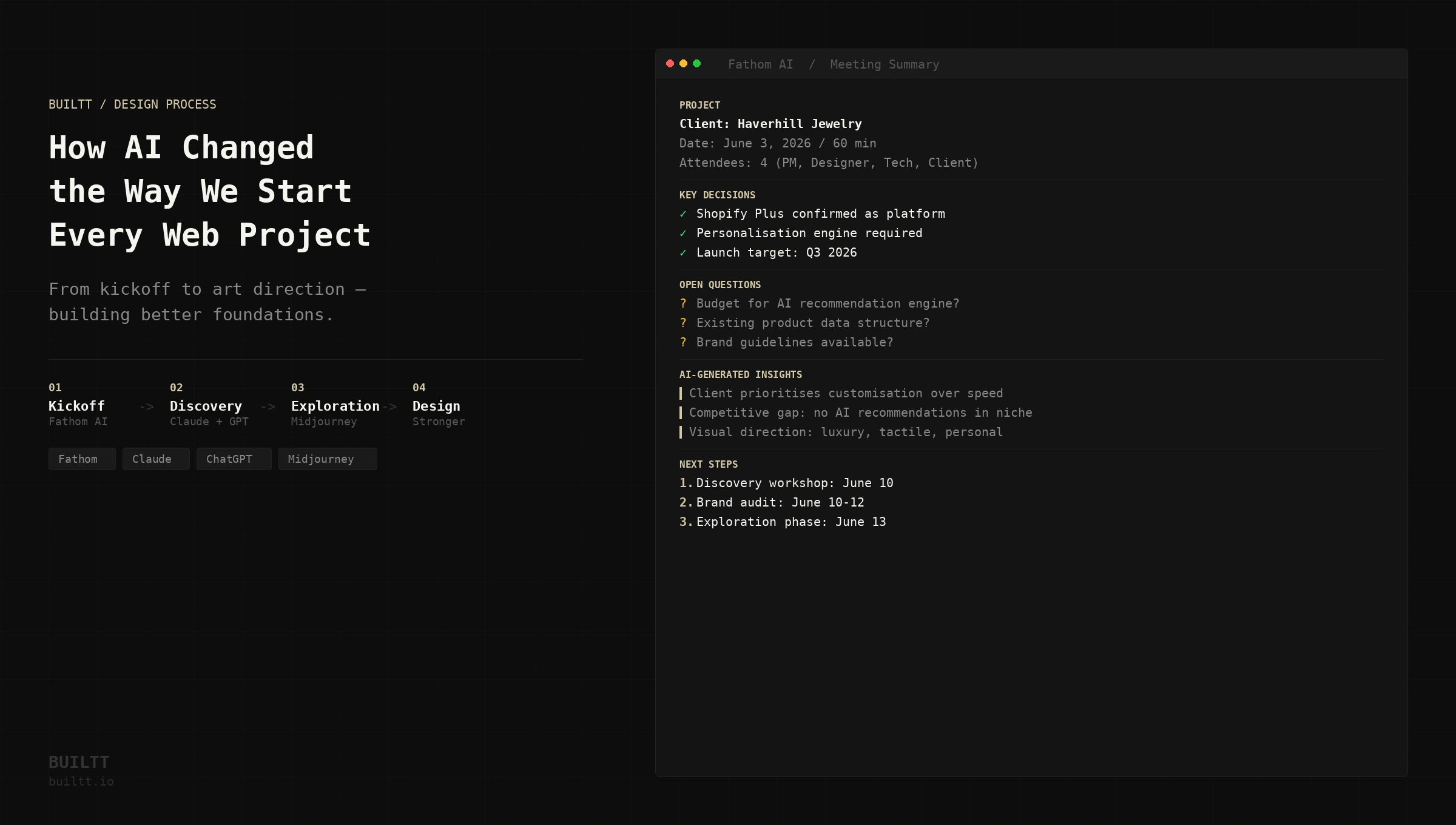
Better foundations produce better design. Here’s how AI helped us build them.
The part of web projects nobody talks about
Everyone talks about design. The visuals, the interactions, the final product. What gets talked about less is everything that happens before design starts — and how much that foundation determines what design can actually achieve.
At Builtt, a web project moves through six phases: kickoff meeting, discovery workshop, exploration, design, development, and launch. The first four phases are where the project is really won or lost. Get them right and design flows. Get them wrong, and you spend the rest of the project correcting course.
These are also the phases in which AI has most significantly changed how we work. Not by replacing judgment — but by giving us more information, faster, so that judgment is better informed when it matters.
How it used to work
Before AI became part of our process, each of the first four phases was largely manual — and each one had its own friction.
The kickoff meeting
A project manager, a designer, and a technical lead would sit with the client. Notes were taken by hand or typed in real time. The output was a meeting document — a summary of what was said, what was agreed, what was still unclear. Inevitably, something got missed. Attention splits between listening and writing. The best note-taker in the room was still a note-taker, not a full participant.
The discovery workshop
Depending on the client and the scope, a discovery workshop could produce tens of documents — questionnaires, brand inputs, competitive references, stakeholder responses. Processing all of that was slow. Sorting it, finding patterns, drawing conclusions — it took time, and the quality of the output depended heavily on who was doing the processing and how much time they had.
The exploration phase
This was where the design team took everything from the kickoff and discovery and started building a visual foundation. Industry research, visual references, competitive analysis — all done manually. Designers would search, screenshot, collect, and organize. Eventually, that material came together in Figma: reference boards, mood directions, early visual hypotheses.
From all of that, the team would produce two or three art direction options. On larger projects, two designers would each produce a direction independently, and a third would be created collaboratively — giving the client as much range as possible within the time available.
The design phase
Design would begin with whatever the exploration phase had produced. The quality of the foundation directly determined the quality of the starting point. And on projects where the exploration phase had been rushed or under-resourced, it showed.
What changed — and how
The shift didn’t happen overnight. It started with one tool, then another, then a process built around what each tool made possible. Here’s how each phase looks now.
Phase 1 — Kickoff meeting: Fathom
We now record every kickoff meeting using Fathom, an AI notetaker that joins the call, transcribes the conversation, and automatically produces a structured summary. The meeting document that used to take 30–60 minutes to write after the call now exists before anyone has closed their laptop.
But the bigger change isn’t speed — it’s presence. The project manager, the designer, and the technical lead are no longer splitting their attention between the client and their notes. They’re fully in the conversation. The questions get better. The observations get sharper. The things that used to fall through the gaps — a tone of voice, an offhand comment about a competitor, a hesitation when a certain topic came up — get noticed.
The result: A richer, more accurate record of the meeting — and a team that was actually present for it.
Phase 2 — Discovery workshop: AI-assisted processing
The discovery workshop still produces a large volume of material — client responses, brand inputs, competitive references, stakeholder notes. What’s changed is what happens to that material afterwards.
We feed the raw output into a combination of AI tools — primarily Claude and ChatGPT — to process, analyze, and synthesize. Patterns that would have taken hours to identify manually surface in minutes. Contradictions get flagged. Priorities get clarified. The output isn’t just faster — it’s more complete, because the AI can hold the entire volume of material in context simultaneously in a way that no individual analyst can.
What we get at the end of this phase is no longer just meeting notes and raw responses. It’s a structured knowledge base: a detailed picture of the client’s business, market, users, ambitions, and the gaps between where they are and where they want to be. That knowledge base becomes the context for everything that follows.
The result: More information, better organized, available faster — and a foundation that the entire project team can reference throughout.
Phase 3 — Exploration: AI-assisted research and art direction
This is where the change is most visible — and most significant.
The exploration phase still involves designers doing their own research. That human judgment — the ability to recognize what feels right, to make lateral connections, to identify what a client is really asking for even when they can’t articulate it — is irreplaceable. What’s changed is the scale and speed at which that research can happen.
In parallel with the manual research, we now use AI tools to gather industry information, competitive references, and visual directions at a pace that wasn’t previously possible. Midjourney and ChatGPT image generation are used to produce visual mood directions — not as finished design, but as fast visual hypotheses that can be tested, refined, and discussed before any production work begins.
The practical result: where we used to produce two or three art directions in the time available, we now regularly produce more — within the same timeframe. But quantity isn’t the point. The point is that each direction is better informed. The brief that feeds into each art direction is richer. The references are more considered. The visual hypotheses are more precise.
Before: 2–3 art directions, built primarily from manual research, produced in a fixed timeframe.
Now: More art directions, each built on a deeper knowledge base, produced in the same or less time.
The result: Design teams enter the design phase with more options, more information, and a clearer picture of what the client actually needs — even when the client couldn’t fully articulate it themselves.
What this means for the design phase
The design phase itself hasn’t changed structurally. Designers still design. The craft, the decisions, the judgment — that’s still human.
What’s changed is what they’re working from.
Every designer on every project now starts with a richer brief, a more complete understanding of the client and their market, and a wider range of validated visual directions to build on. The foundation is stronger. And a stronger foundation produces stronger design.
The quality bar has moved. Not because we changed how we design — but because we changed how thoroughly we prepare to design.
The tools, briefly
For transparency, here’s what’s in our current stack for these phases:
- Fathom — AI notetaker for kickoff meetings and workshops. Records, transcribes, and summarizes automatically.
- Claude and ChatGPT — used for processing discovery material, identifying patterns, synthesizing knowledge bases, and generating structured analysis.
- Midjourney and ChatGPT image generation — used for visual research, mood direction generation, and rapid art direction exploration.
None of these tools replaces designers, project managers, or the strategic thinking that occurs during these phases. They extend what’s possible within the time available — and they raise the quality of the input that design receives.
Why this matters beyond efficiency
The easy way to talk about AI in a design process is to talk about speed. Faster notes. Faster research. Faster art directions.
Speed is real. But it’s not the most important thing.
The more important thing is depth. The knowledge we bring into a project’s design phase is now qualitatively different from what it was before. More of the client’s context is captured. More of the market is understood. More visual directions have been explored and validated before production begins.
Design built on that foundation is more considered, more precise, and more defensible. When a client asks why a direction looks or feels a certain way, the answer is grounded in evidence — not instinct alone.
That’s what we mean when we say AI raised our quality by a level. Not that the tools design for us. But that they made the foundation stronger — and everything built on a stronger foundation reaches higher.
Working on a web project?
If you’re planning a website, an e-commerce build, or a digital product — this is the process you’d be working within. A team that uses every available tool to understand your business deeply before design begins.